
The Pikler Approach for At-Home Use
"Give me some time"
Hungarian paediatrician Emmi Pikler developed an educational approach based entirely on trust, respect and the ‘free development of movement’. As a parent practising the Pikler method, there is one thing above all that you need to learn: to keep your hands to yourself and give your baby time. We’ll show you how this relaxed approach works.
⏱️ The essentials of the Pikler method
- No passive positioning: A child is never placed in a position they cannot achieve through their own efforts.
- Free development: Babies learn to roll over, crawl, sit and walk entirely on their own. Parents do not intervene to help them or practise these skills with them.
- Observe rather than encourage: The baby is laid on their back. Parents watch attentively but do not impose themselves as ‘entertainers’.
- Respectful care: Nappy changes, baths and feeding are not tedious chores, but rather valuable opportunities for guided bonding on an equal footing.
Free motor development
Emmi Pikler was convinced that every healthy child carries within them a blueprint for their motor development. When we intervene, for example by sitting a child down before their back muscles are strong enough, we disrupt this natural process.
The safe space: From birth, the baby is placed on their back, their safest position, on a firm blanket on the floor. They are given plenty of space and simple materials within easy reach.
The power of trial and error: Through endless repetition, the baby learns how to roll onto their side and later onto their tummy, how to push themselves up onto all fours and, finally, how to sit up by themselves. Each of these small steps requires courage and greatly boosts the child’s self-confidence: ‘I can do this all by myself.’
Mindful observation
The Pikler approach relieves parents of the pressure to constantly entertain their child. Instead of faffing about in front of the child with rattles and play arches, parents take on an observational role. They are physically and emotionally present as a ‘safe haven’, but allow the baby to have their own experiences. Boredom is allowed, as it gives rise to the desire to turn to something new of their own accord.
Respectful care as relationship-building
An often overlooked but fundamental part of the Pikler approach is care. For a baby, having their nappy changed or being dressed is not a trivial matter, but an opportunity for intimate time with their parents.
- Announcing what is going to happen: In the Pikler approach, the baby is not simply picked up and changed. Every step is explained: ‘I’m going to unbutton your bodysuit now. I’m going to lift your little legs briefly.’
- Cooperation rather than coercion: The baby is invited to take part, for example by putting their arm into the sleeve themselves as soon as they are able to. Care is given time and space, which helps the baby feel safe, respected and valued.
🛍️ Tools for free development
If you’d like to put the Pikler philosophy into practice at home, you’ll find suitable aids here:
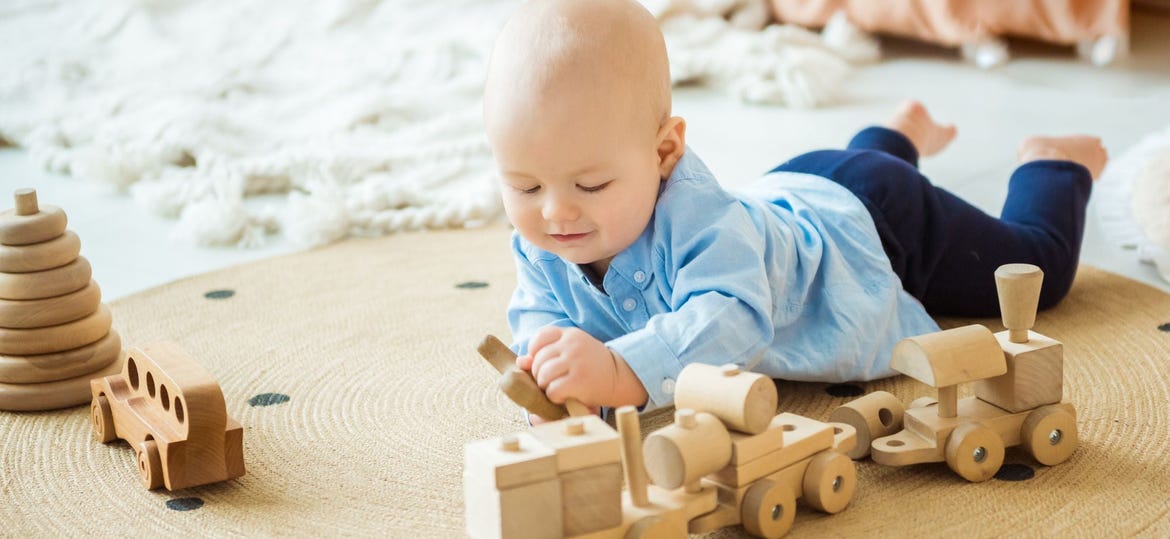
Wooden toys: High-quality wooden grasping toys or durable playthings that give your child scope to use their own imagination, rather than simply entertaining them passively.
Equipment: Sturdy, large play mats and blankets on which your baby can find firm footing while practising rolling over and crawling safely.
Baby & child care: Gentle care products for those special moments on the changing table, with plenty of time and care.
Frequently asked questions about the Pikler approach
What should I do if my baby is unhappy lying on their back?
When a baby cries, they should of course be comforted straight away, picked up and cuddled. Pikler does not mean ignoring the child. It simply means that, once they are full and content, they are given regular opportunities to explore lying on their back without fear.
When do I need a Pikler triangle?
The well-known wooden Pikler triangle is a useful climbing frame, but it is not needed for babies during their first six months. It only comes into use once your child starts pulling themselves up unaided, usually from around 9 to 12 months. Before that, a flat blanket on the floor is perfectly sufficient.
My child can’t sit up yet. Can they sit in the high chair?
According to strict Pikler principles, a child who cannot yet sit up independently from a lying or crawling position should not be seated for meals, as their core muscles are not yet sufficiently developed. In practice, many parents following the Pikler approach feed their babies on their lap when introducing solid foods, with the baby’s back supported against the parent’s body.
Related products
-

Eichhorn Rattle
- Makes great noises
- FSCⓇ-certified beech wood
- Recommended from 3 months
-
small foot Motor Skills Board - Fasteners and Laces
- Play & learn
- With over 14 fasteners
- Helps improve fine motor skills
-
small foot Threading Shoe
- Trains fine motor skills
- Colourful design
- Also great for on the go
-
small foot Wooden Blocks natural 100-pack in bag
- Cube: 3 x 3 x 3 cm
- Cuboid: 3 x 3 x 6 cm
- Promotes spatial thinking
Magazine Articles:
-
Great Britain: Free standard delivery from £69.90
-
Free
returns Secure payments
with SSL encryption technology